Untitled post 91
MEMBRANE
Buyer’s Guide · Updated June 2026

How to Choose the Right
Waterproofing Membrane

A practical guide to choosing between APP and SBS bitumen membranes, thickness, reinforcement, and warranty — before you sign with any contractor.

Not all waterproofing membranes are the same — and the difference between the right one and the wrong one is the difference between a roof that’s dry for ten years and one that leaks again next monsoon.

Most homeowners never get to ask these questions before a contractor starts work. This guide walks through exactly what to check, in the order it matters.

Step 1

APP or SBS? Start with your climate, not the price tag

Almost every modified bitumen membrane on the market is either APP or SBS. These two letters matter more than brand name, because they determine how the membrane behaves on your actual roof.

APP — Plastomeric

Best for: Lahore’s heat & direct sun

Atactic Polypropylene gives the membrane increased crystallinity and heat resistance, tolerating higher service temperatures with excellent UV durability when exposed directly to sun.

Stays rigid in extreme heat — ideal for flat exposed roofs that bake all summer.

SBS — Elastomeric

Best for: Movement & structural cracks

Styrene-Butadiene-Styrene imparts rubber-like elasticity to the bitumen, widening the plasticity range and improving crack-bridging at joints and penetrations.

Bends with the building instead of fighting it — better around pipes, edges, and basements.

Quick rule of thumb Flat, sun-exposed rooftop with no structural movement → lean APP. Basement, foundation, or a roof with visible hairline cracks → lean SBS. Many Lahore homes benefit from a layered system using both.

Step 2

Thickness and reinforcement decide the lifespan

A thin membrane with weak reinforcement will fail no matter how good the polymer is. This is the detail most contractors skip explaining — and the one that determines whether you’re back here in 3 years or 15.

01
Membrane thickness

For roof applications, 3–4mm is the practical minimum. A 4–5mm polyester-reinforced cap sheet will outlast a thin, glass-reinforced one regardless of polymer type.

02
Reinforcement type

Polyester reinforcement gives better tensile strength and dimensional stability. Fiberglass is cheaper but more brittle and prone to tearing during installation.

03
Single vs. two-ply system

Two-ply systems (underlay + cap sheet) remain the standard for serious roofs because they provide a second barrier if the first layer develops a localized fault.


Step 3

How it’s installed matters as much as what’s installed

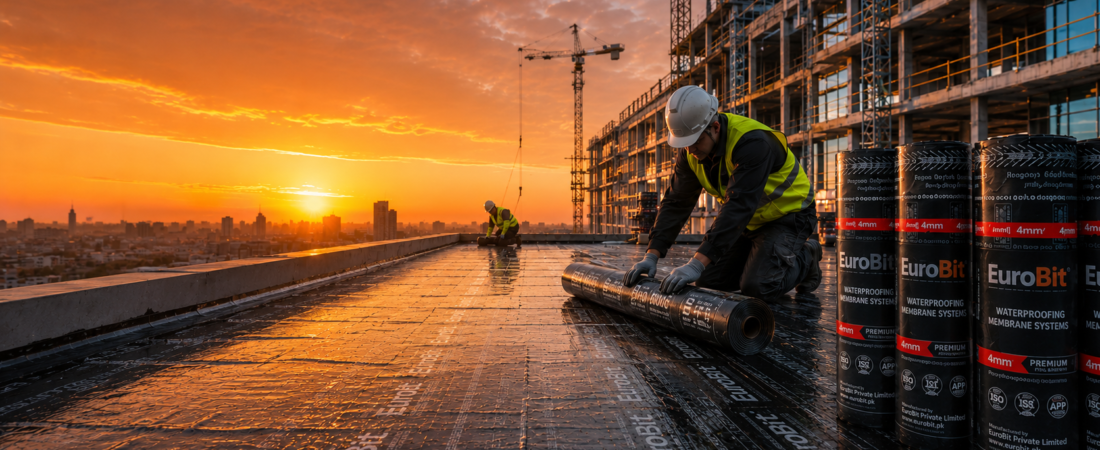
The same membrane, badly torched on, fails in one season. Ask your contractor which method they use and why.

Torch-applied (heat-welded): The traditional method. Strong seams when done correctly, but requires a skilled installer — a rushed job leaves weak overlap joints that fail first.
Self-adhesive: No open flame, faster, more consistent results because the adhesive layer is factory-applied rather than relying on installer skill in the field.
Cold adhesive: Used for SBS membranes in flame-free specifications — safer around occupied buildings but the bond quality depends heavily on surface prep.

Step 4

Red flags before you sign a contract

These are the most common ways homeowners get sold a membrane that won’t last.

No mention of thickness or reinforcement type — if a quote only says “waterproofing membrane” without specs, you can’t compare it to anything.
Verbal warranty only — if it’s not written and signed, it does not exist when something goes wrong in year three.
No ASTM or EN standard cited — credible manufacturers reference ASTM D6162 or EN 13707 on their technical data sheets. If they can’t produce a data sheet, ask why.
One product sold for every problem — roof, basement, and bathroom seepage are different problems. A contractor offering the same membrane for all three probably isn’t matching the system to your actual issue.
Quick decision guide
Flat exposed roof
APP, 4mm+, polyester
Basement / foundation
SBS, crystalline base, sealed joints
Bathroom / wet area
Polymer grout + epoxy injection
Old roof with cracks
SBS for flexibility, two-ply
🛡️
Still unsure which membrane fits your roof?

Get a free technical assessment.

Eurobit manufactures APP and SBS membranes in Lahore — ASTM-standard, ISO 9001:2015 certified, with up to 10-year written warranty.

Eurobit Private Limited — Protection · Stability · Longevity — www.eurobit.online

MEMBRANE
Buyer’s Guide · Updated June 2026

How to Choose the Right
Waterproofing Membrane

A practical guide to choosing between APP and SBS bitumen membranes, thickness, reinforcement, and warranty — before you sign with any contractor.

Not all waterproofing membranes are the same — and the difference between the right one and the wrong one is the difference between a roof that’s dry for ten years and one that leaks again next monsoon.

Most homeowners never get to ask these questions before a contractor starts work. This guide walks through exactly what to check, in the order it matters.

Step 1

APP or SBS? Start with your climate, not the price tag

Almost every modified bitumen membrane on the market is either APP or SBS. These two letters matter more than brand name, because they determine how the membrane behaves on your actual roof.

APP — Plastomeric

Best for: Lahore’s heat & direct sun

Atactic Polypropylene gives the membrane increased crystallinity and heat resistance, tolerating higher service temperatures with excellent UV durability when exposed directly to sun.

Stays rigid in extreme heat — ideal for flat exposed roofs that bake all summer.

SBS — Elastomeric

Best for: Movement & structural cracks

Styrene-Butadiene-Styrene imparts rubber-like elasticity to the bitumen, widening the plasticity range and improving crack-bridging at joints and penetrations.

Bends with the building instead of fighting it — better around pipes, edges, and basements.

Quick rule of thumb Flat, sun-exposed rooftop with no structural movement → lean APP. Basement, foundation, or a roof with visible hairline cracks → lean SBS. Many Lahore homes benefit from a layered system using both.

Step 2

Thickness and reinforcement decide the lifespan

A thin membrane with weak reinforcement will fail no matter how good the polymer is. This is the detail most contractors skip explaining — and the one that determines whether you’re back here in 3 years or 15.

01
Membrane thickness

For roof applications, 3–4mm is the practical minimum. A 4–5mm polyester-reinforced cap sheet will outlast a thin, glass-reinforced one regardless of polymer type.

02
Reinforcement type

Polyester reinforcement gives better tensile strength and dimensional stability. Fiberglass is cheaper but more brittle and prone to tearing during installation.

03
Single vs. two-ply system

Two-ply systems (underlay + cap sheet) remain the standard for serious roofs because they provide a second barrier if the first layer develops a localized fault.


Step 3

How it’s installed matters as much as what’s installed

The same membrane, badly torched on, fails in one season. Ask your contractor which method they use and why.

Torch-applied (heat-welded): The traditional method. Strong seams when done correctly, but requires a skilled installer — a rushed job leaves weak overlap joints that fail first.
Self-adhesive: No open flame, faster, more consistent results because the adhesive layer is factory-applied rather than relying on installer skill in the field.
Cold adhesive: Used for SBS membranes in flame-free specifications — safer around occupied buildings but the bond quality depends heavily on surface prep.

Step 4

Red flags before you sign a contract

These are the most common ways homeowners get sold a membrane that won’t last.

No mention of thickness or reinforcement type — if a quote only says “waterproofing membrane” without specs, you can’t compare it to anything.
Verbal warranty only — if it’s not written and signed, it does not exist when something goes wrong in year three.
No ASTM or EN standard cited — credible manufacturers reference ASTM D6162 or EN 13707 on their technical data sheets. If they can’t produce a data sheet, ask why.
One product sold for every problem — roof, basement, and bathroom seepage are different problems. A contractor offering the same membrane for all three probably isn’t matching the system to your actual issue.
Quick decision guide
Flat exposed roof
APP, 4mm+, polyester
Basement / foundation
SBS, crystalline base, sealed joints
Bathroom / wet area
Polymer grout + epoxy injection
Old roof with cracks
SBS for flexibility, two-ply
🛡️
Still unsure which membrane fits your roof?

Get a free technical assessment.

Eurobit manufactures APP and SBS membranes in Lahore — ASTM-standard, ISO 9001:2015 certified, with up to 10-year written warranty.

Eurobit Private Limited — Protection · Stability · Longevity — www.eurobit.online